
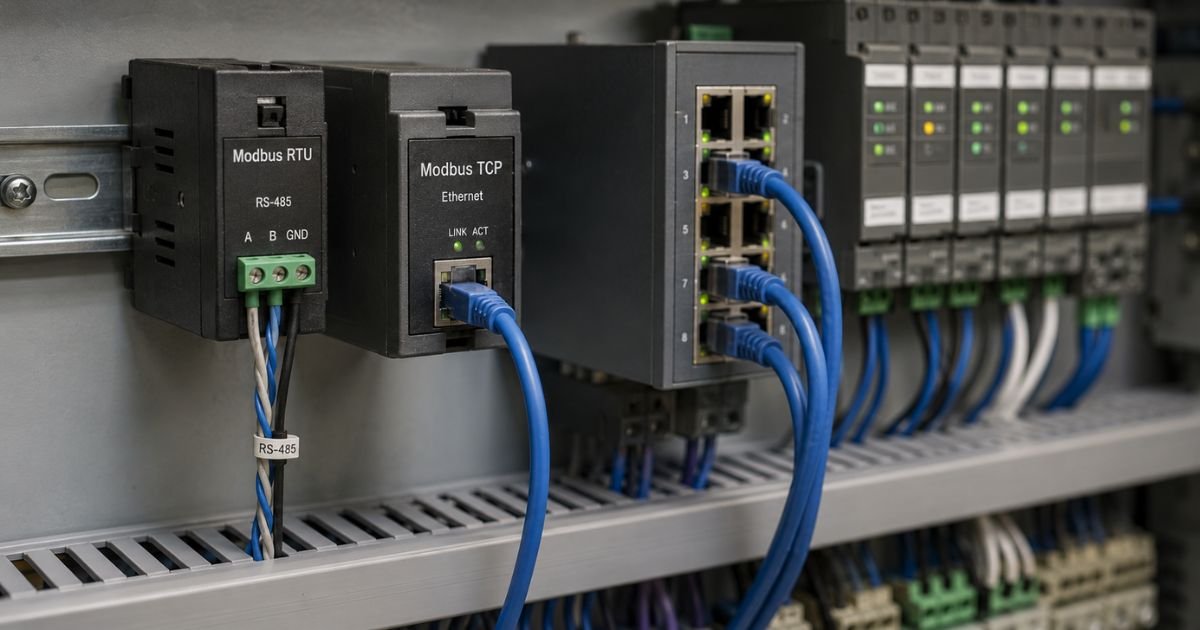
Modbus remains one of the most widely used industrial communication protocols. Two of its most common versions are Modbus RTU and Modbus TCP.
They share the same core data model and function codes, yet they travel over completely different physical layers.
Modbus RTU runs on serial links such as RS-485. Modbus TCP rides on standard Ethernet using TCP/IP. That single change affects speed, distance, number of devices, wiring cost, and how you design the system.
This guide explains how each version works, compares them side by side, and helps you decide which one fits your project.
Modbus RTU vs Modbus TCP
What Is Modbus RTU?
Modbus RTU (Remote Terminal Unit) is the classic serial version of the protocol. It sends compact binary messages over RS-485 or RS-232.
A single master polls one or more slaves. Each message starts with a 1-byte slave address (1–247), followed by a function code, the data, and a 2-byte CRC-16 checksum. The master and slaves detect the end of a message by measuring silence on the line (usually 3.5 character times).
RS-485 allows multi-drop buses. You can connect up to 32 devices on one segment without repeaters, and the bus can stretch to about 1,200 meters at lower baud rates. Typical speeds range from 9,600 to 115,200 baud.
RTU is simple, inexpensive, and very common on older meters, variable-frequency drives, temperature controllers, and many field sensors.
What Is Modbus TCP?
Modbus TCP takes the exact same application-layer data and wraps it inside TCP/IP packets. It runs over ordinary Ethernet on TCP port 502.
Instead of a slave address and CRC, every message begins with a 7-byte MBAP header. The header contains a transaction ID, a protocol ID (always 0 for Modbus), the length of the following data, and a Unit ID. The Unit ID often maps to the old slave address when a gateway sits between serial and Ethernet devices.
Because TCP itself guarantees delivery and handles errors, Modbus TCP drops the CRC. Multiple clients can talk to the same server at the same time. Speeds jump from kilobits to 10, 100, or even 1,000 Mbps.
Modbus TCP shines in modern plants that already have Ethernet switches, SCADA systems, and higher-level networks.
Side-by-Side Comparison
| Feature | Modbus RTU | Modbus TCP |
|---|---|---|
| Physical layer | RS-485 or RS-232 | Ethernet (TCP/IP) |
| Framing | Binary + CRC-16 | Binary + 7-byte MBAP header |
| Error checking | CRC-16 | TCP checksums and retransmission |
| Addressing | Slave ID 1–247 | IP address + Unit ID |
| Typical speed | 9,600–115,200 baud | 10/100/1,000 Mbps |
| Max distance | ~1,200 m (low baud) | 100 m per copper segment (extendable) |
| Masters / clients | One master per bus | Multiple simultaneous clients |
| Max devices | ~32 per segment (more with repeaters) | Limited mainly by IP network |
| Wiring | Twisted-pair serial cable | Standard Cat5/Cat6 Ethernet |
| Best for | Legacy field devices, long runs | Modern SCADA, high poll rates |
Both versions use the same four data areas (coils, discrete inputs, input registers, holding registers) and the same function codes. The difference lives entirely in the transport.
Key Technical Differences Explained
Physical Layer and Topology
RTU uses a shared serial bus. Only one device talks at a time. You must manage baud rate, parity, stop bits, and termination resistors carefully.
TCP uses a switched Ethernet network. Devices can talk in parallel. You assign IP addresses and usually leave the default port 502 open (or firewall it).
Error Detection
RTU relies on its own CRC. A single flipped bit can make the whole frame invalid, and the master simply times out.
TCP leans on the network stack. Packets that fail the TCP checksum get retransmitted automatically. Timing is no longer deterministic, but reliability on a healthy network is high.
Speed and Latency
At 9,600 baud an RTU transaction for a few registers often takes 50–100 ms. Ten devices can push the full poll cycle past one second.
On 100 Mbps Ethernet the same transaction often finishes in 5–15 ms. You can poll many more devices at higher rates and even pipeline requests.
Number of Masters
RTU allows only one master. If two masters try to share the bus, collisions destroy data.
TCP supports many clients. A SCADA system, a historian, and a maintenance laptop can all read the same PLC at once.
Advantages of Modbus RTU
- Extremely low hardware cost
- Excellent noise immunity on properly shielded RS-485
- Long cable runs without extra infrastructure
- Simple configuration (no IP addresses)
- Huge installed base of legacy devices
RTU remains the default choice whenever the device only has a serial port or the installation has no Ethernet.
Advantages of Modbus TCP
- Far higher throughput
- Multiple simultaneous clients
- Easy integration with modern SCADA, MES, and cloud gateways
- Uses existing Ethernet switches and cabling
- No baud-rate or timing-gap headaches
TCP becomes the clear winner when you need speed, scale, or network-wide visibility.
When to Choose Each Protocol
Choose Modbus RTU when:
- Devices only offer RS-485 or RS-232 ports
- Cable runs exceed 100–200 meters and Ethernet is not present
- You want the simplest possible wiring
- Device count stays modest and poll rates are low
Choose Modbus TCP when:
- Devices already have Ethernet ports
- You need to poll many registers quickly
- Multiple systems must access the same data
- The plant already runs on Ethernet
Many real systems use both. A serial-to-Ethernet gateway converts RTU messages to TCP (and vice versa) so legacy instruments can join a modern network.
Common Implementation Tips
For RTU: Terminate the bus at both ends with 120-ohm resistors, use shielded twisted pair, and keep the baud rate the same on every device. Watch the inter-character timing; noisy cables can break the silent-gap framing.
For TCP: Assign static IPs or use DHCP reservations. Open port 502 only where needed and consider a firewall or VPN for remote access. Remember that Modbus itself has no authentication, so network security matters more than on a pure serial bus.
Gateways are widely available and usually transparent once you map the Unit ID to the correct serial slave address.
FAQs About Modbus RTU vs Modbus TCP
Q: Do Modbus RTU and Modbus TCP use the same registers?
Yes. The data model, register addresses, and function codes are identical. Only the way messages travel changes.
Q: Is Modbus TCP always faster in practice?
Yes for multi-device systems. A single short RTU transaction can be quick at high baud rates, but Ethernet wins as soon as you add devices or increase the poll rate.
Q: Can I mix RTU and TCP devices on the same network?
Not directly. You need a Modbus gateway or protocol converter that translates between the serial RTU frames and the Ethernet TCP packets.
Q: Which protocol is more secure?
Neither includes built-in authentication or encryption. RTU benefits from physical isolation of the serial cable. TCP sits on an IP network, so you must protect port 502 with firewalls, VLANs, or secure tunnels.
Conclusion
Modbus RTU and Modbus TCP share the same application language but speak it over different media. RTU stays the reliable, low-cost choice for serial field devices and long cable runs. TCP brings speed, multi-client access, and easy integration with modern Ethernet networks.
Look at the ports on your devices, the existing cabling, the required poll rate, and the number of systems that need access. Those factors almost always point clearly to one protocol or to a simple gateway that joins both worlds.
Once you understand the transport differences, choosing and troubleshooting Modbus becomes straightforward.
Disclaimer: This article is for educational purposes. Always consult the official Modbus specifications and your device manuals for exact implementation details, timing requirements, and safety considerations in industrial environments.