
Picture this. You flip a switch on your digital thermostat and the temperature changes instantly. Or you snap a photo on your phone and the image looks crystal clear.
Behind these everyday miracles sits a simple but powerful idea called binary weighting. It might sound like something only engineers care about, but it quietly runs almost every gadget you own.
Binary weighting is the way each digit in a binary number gets its own “importance” or value based on its position.
Just like the number 123 in decimal has a 1 worth 100, a 2 worth 20, and a 3 worth 3, binary weighting assigns powers of two to each bit. This concept turns raw 0s and 1s into useful signals that control voltage, current, and data in electronic circuits.
In this guide you will learn exactly what binary weighting is, how it works step by step, and why it matters so much in electronics. You will see real examples, handy tips, and even a few common pitfalls to avoid.
Whether you are a curious hobbyist, a student, or someone who just wants to understand the tech in your pocket, you will walk away with clear answers and fresh confidence.
What Is Binary Weighting?
Binary weighting simply means giving each position in a binary number a specific value based on powers of two. The rightmost bit is always worth 2^0, which equals 1. The next bit to the left is worth 2^1, or 2. Then comes 4, 8, 16, and so on.
This system lets computers and circuits turn a string of 1s and 0s into real-world numbers or voltages. Without it, your devices could not translate digital instructions into actions you can see or feel. It is the bridge between the on-off language of electronics and the useful results you expect.
How Binary Weighting Works in Practice
Let us break it down with a quick example. Take the binary number 1011.
- The rightmost 1 is in the 2^0 position, so it equals 1.
- The next 1 is in the 2^1 position, so it equals 2.
- The 0 in the 2^2 position adds nothing.
- The leftmost 1 is in the 2^3 position, so it equals 8.
Add them up: 8 + 0 + 2 + 1 = 11 in decimal. That is binary weighting in action.
You can use this same idea for larger numbers too. An 8-bit binary number can represent values from 0 all the way up to 255 because the leftmost bit is worth 128. It is elegant, efficient, and exactly why your computer can handle huge amounts of data without breaking a sweat.
Binary Weighting in Electronics
Binary weighting shines brightest inside electronic circuits. Engineers use it to design digital-to-analog converters, or DACs, that turn digital signals into smooth analog voltages. They also rely on it for analog-to-digital converters that do the opposite job.
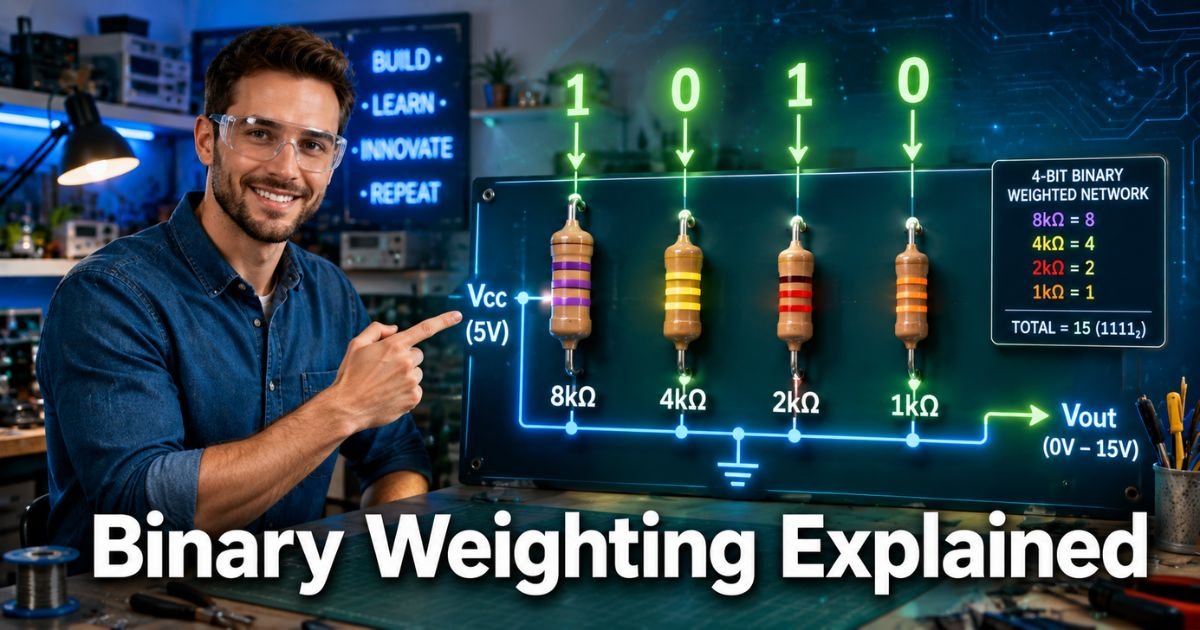
In a typical binary-weighted resistor network, each resistor doubles in value to match the binary place values. A 1 in the least significant bit might flow through a 10kΩ resistor, while a 1 in the next position flows through a 5kΩ resistor, and so on. The currents add up in perfect proportion, creating an output voltage that matches the original binary number.
This same principle appears in LED displays, motor controllers, audio equipment, and even the tiny chips inside your fitness tracker. Once you understand binary weighting in electronics, you start seeing it everywhere.
Why Binary Weighting Matters in Electronics
Binary weighting matters because it makes electronics precise, fast, and power-efficient. Without it, circuits would need far more complicated designs to handle the same tasks. Here are three big reasons it is essential:
- Accuracy: Each bit contributes exactly the right amount of voltage or current, so the final output stays true to the digital input.
- Simplicity: Doubling resistor values is easy to build and easy to scale for more bits.
- Speed: The weighted system works instantly inside chips, letting your devices respond in real time.
Think about your smartphone camera. It captures light, converts it to binary data using weighting principles, and then processes the image in a split second. That smooth experience you love? Binary weighting is quietly making it possible.
Real-World Example: Meet Alex, the Weekend Inventor
Take Alex, a 32-year-old software developer who loves building gadgets on weekends. He wanted to create a simple mood lamp that changed brightness based on the time of day. Using an Arduino and a few resistors, Alex set up a 4-bit binary-weighted DAC.
He assigned weights of 1, 2, 4, and 8 to his resistors so each binary command from his code produced exactly the right voltage for the LED. When he tested it, the lamp faded perfectly from dim to bright without any flicker.
Alex told his friends it was the moment he finally understood why his college circuits class kept talking about binary weighting. His little project now sits on his desk, reminding him every evening how one clever idea can light up a room.
Pro Tip: When building your own circuit, label each resistor with its binary weight right on the breadboard. It makes troubleshooting way easier and helps you catch mistakes before you power everything up!
Common Mistake to Avoid
Common Mistake: Mixing up the most significant bit and least significant bit when calculating weights. Many beginners treat every bit as equal, which throws off the entire voltage output and can damage components. Always start from the right with 2^0 and work left.
Quick Reference Table of Binary Weights
Here is a handy table showing binary weights for a common 8-bit system. Keep it nearby when you are experimenting.
| Bit Position | Binary Weight | Decimal Value | Example Binary |
|---|---|---|---|
| 7 (MSB) | 2^7 | 128 | 10000000 |
| 6 | 2^6 | 64 | 01000000 |
| 5 | 2^5 | 32 | 00100000 |
| 4 | 2^4 | 16 | 00010000 |
| 3 | 2^3 | 8 | 00001000 |
| 2 | 2^2 | 4 | 00000100 |
| 1 | 2^1 | 2 | 00000010 |
| 0 (LSB) | 2^0 | 1 | 00000001 |
8-bit binary weighting values and examples for quick reference.
More Ways Binary Weighting Shows Up in Your Daily Life
From the volume knob on your wireless earbuds to the way your car’s anti-lock brakes process sensor data, binary weighting keeps everything running smoothly. It even helps save battery life because circuits can turn off unneeded bits without wasting power.
Engineers keep improving these designs, but the core idea of binary weighting stays the same. It is one of those foundational concepts that just keeps delivering results year after year.
FAQs About What is binary weighting
How does binary weighting work inside a digital-to-analog converter?
In a DAC, each bit controls a resistor that is weighted by powers of two. When the bit is 1, current flows through its resistor. All the currents add together at the output, creating a voltage that exactly matches the original binary number. This gives you a smooth analog signal from a simple digital input.
What is the difference between binary weighting and other resistor ladder methods?
Binary weighting uses resistors that exactly double in value for each bit, which is simple but can need a wide range of resistor sizes. Other methods, like the R-2R ladder, use only two resistor values for easier manufacturing. Both achieve the same goal, but binary weighting often feels more intuitive for beginners.
Why is binary weighting important for hobbyists building Arduino projects?
It lets you control precise voltages and currents with just a few lines of code and cheap parts. Understanding binary weighting helps you create accurate LED dimmers, motor speed controllers, or even simple audio players without buying expensive modules. It turns basic components into powerful tools.
CONCLUSION
You now have a solid grasp of what binary weighting is and why it matters so much in electronics. You have seen how each bit carries its own power-of-two value, how circuits use that value to create useful signals, and why the whole system makes modern gadgets fast and reliable.
The next time you use your phone, turn on a smart light, or even check your fitness tracker, you will know a little secret about the invisible math making it all work.
Grab a breadboard and a few resistors this weekend and try a simple weighted circuit yourself. You will be amazed how quickly it clicks. Keep tinkering, keep learning, and enjoy the satisfaction of understanding the electronics all around you.
Disclaimer: This content is for informational and educational purposes only and does not constitute professional, financial, legal, or medical advice. The information provided may not apply to your specific situation. Always consult a qualified professional for personalized guidance.