
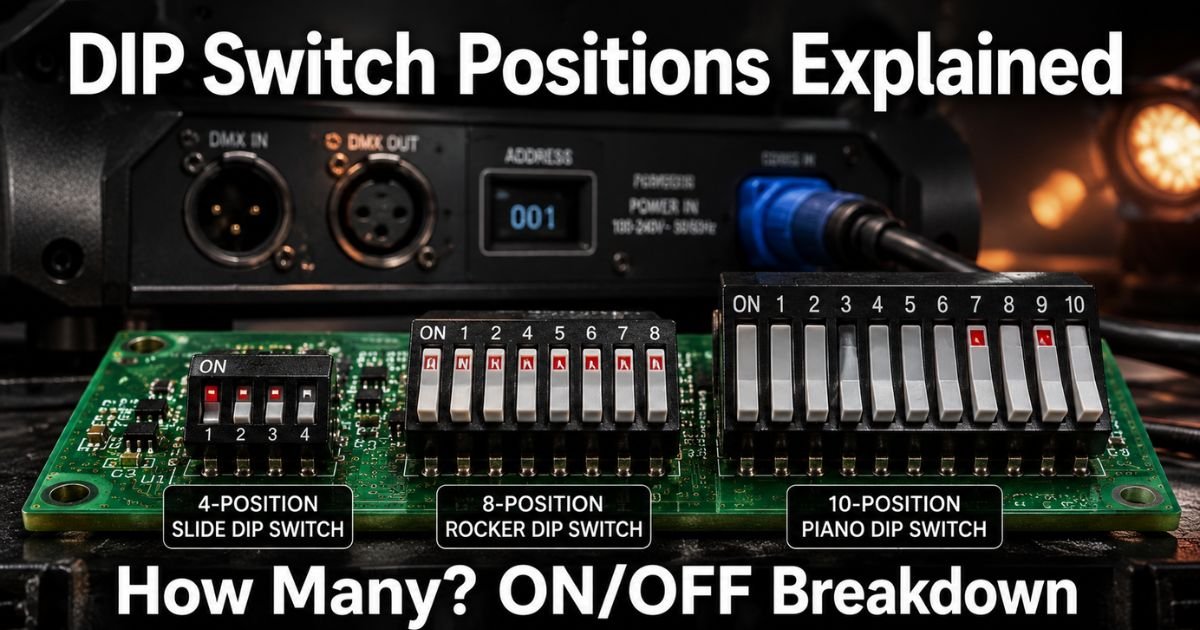
Ever cracked open a moving head light or an old piece of electronics gear and spotted those tiny rows of switches, only to wonder exactly how many positions a DIP switch supports? It is one of those small but mighty details that can make or break your entire setup.
Whether you are setting DMX addresses on stage lights or tweaking a circuit board at home, knowing the answer keeps your gear running smoothly without guesswork.
We will unpack everything about DIP switch positions in a way that feels straightforward and practical. I will share real examples that actually help. By the end, you will feel confident picking the right DIP switch for any job.
Understanding DIP Switch Positions: From Basics to Pro Setups
DIP switches, short for Dual In-line Package switches, come in all shapes and sizes. But when folks ask how many positions a DIP switch supports, they usually mean one of two things. First, how many individual switches sit inside that little package? And second, how many ways can each of those switches actually flip?
The answer is simpler than it sounds, yet it opens up a world of reliable control for everything from moving head lights to industrial controls.
Most people run into these switches when programming DMX addresses. You flip them to tell your fixture exactly which channel block it should listen to. Get the position count right, and your whole rig communicates perfectly.
Miss it, and you are troubleshooting chaos at load-in time. Now, let us break it down so you never have to second-guess again.
What Does “Positions” Really Mean in a DIP Switch?
Here is the key point that clears up most confusion. When manufacturers label a switch as an “8-position DIP switch,” they are talking about the number of individual toggles inside the package. Each one of those toggles supports exactly two positions: ON and OFF.
It is that binary magic that makes DIP switches so useful. One switch gives you 2 choices. Two switches give you 4 possible combinations. And it keeps doubling from there. This design has been rock-solid since the 1970s because it is cheap, dependable, and needs zero software to work.
Common DIP Switch Position Counts and Where You Find Them
DIP switches do not come in just one flavor. They range from super simple 1-position up to 16-position packages for more complex jobs. Here is a quick look at the most popular sizes and what they handle best.
| DIP Switch Positions | Total Possible Configurations | Best Real-World Uses | Example in Lighting Rigs |
|---|---|---|---|
| 4-position | 16 | Small devices, basic settings | Budget audio interfaces |
| 6-position | 64 | Home electronics, simple controls | Network routers |
| 8-position | 256 | Standard addressing | Entry-level par cans |
| 9-position | 512 | DMX address (1-511) | Basic moving head lights |
| 10-position | 1,024 | DMX plus mode selection | Professional moving head lights |
| 12-position | 4,096 | Advanced industrial or testing | Large festival consoles |
You can see why 8-position and 10-position versions dominate the stage lighting world. For most moving head lights, those nine address switches cover the full 511 DMX channels, while the tenth often flips between modes. It is no accident. Manufacturers picked these counts to match real-world needs without wasting space.
How Each Individual Switch Works: The Two-Position Reality
Every single toggle inside a DIP switch package gives you just two positions. Flip it one way for ON. Flip it the other for OFF. That is it. Whether you are using rocker, slide, or piano styles from our last chat, the electrical result stays the same.
Rocker switches rock back and forth with a satisfying click. Slide switches glide along a track and stay low-profile. Piano switches pop up like tiny keys for quick finger adjustments. But all of them still deliver only ON or OFF per position.
This binary setup is what powers the math behind DMX addressing. Remember our earlier example? To set address 100, you add the values of the switches you turn ON: 64 plus 32 plus 4. Each position contributes its binary weight or nothing at all. Super simple once you see the pattern.
Calculating Total Configurations for Your Setup
Here is where the fun really begins. With n positions in your DIP switch, you get 2 raised to the power of n possible combinations. An 8-position switch gives 256 unique settings. A 10-position model jumps to 1,024. That is plenty of room for most pro lighting needs.
Let me walk you through a quick real-world calculation. Suppose you have three moving head lights, each needing 14 channels. You set the first at address 1. The second must start at 15 to avoid overlap. If your fixture uses a 10-position DIP switch, you have more than enough combinations to handle an entire small stage without conflict.
Tying DIP Switch Positions Back to Moving Head Lights and DMX
If you have been following along with our earlier guides on setting DMX addresses or choosing rocker versus piano styles, this all connects beautifully. Most moving head lights ship with either 8-position or 10-position DIP switches. The extra positions give you flexibility for different channel modes or test patterns.
Always check your fixture manual first. Some brands label the switches 1 through 9 for addressing and 10 for mode selection. Flip the mode switch to OFF (or whatever the manual says) and you are ready for full DMX control. It is one of those small habits that separates weekend warriors from seasoned techs.
Pro tip: label each light with its address right after you set the DIP switches. A strip of gaffer tape works wonders when you are rushing between acts.
Tips for Working With Any Position Count
No matter how many positions your DIP switch has, a few smart habits keep everything reliable. Always power down the device before flipping switches. Dust can sneak in and cause flaky connections over time, so a quick blast of compressed air helps. And if you are mixing different position counts in one rig, sketch a quick chart on your phone to stay organized.
For bigger productions, consider keeping a few spare 10-position DIP switches in your tool bag. They are inexpensive and can bail you out when a fixture goes down mid-show. I learned that lesson the hard way at an outdoor festival when one light refused to respond until we swapped the whole switch package.
You can find great reference charts and datasheets on sites like Digi-Key or Mouser Electronics. They break down everything from physical dimensions to current ratings.
Common Mistakes and How to Avoid Them
One of the biggest slip-ups I see is assuming all DIP switches with the same position count behave identically. Not true. Some 8-position models are designed for low-current signals only, while others handle more robust applications. Always match the specs to your gear.
Another frequent error is forgetting to power cycle after changes. The fixture will not read the new settings until it reboots. And yes, overlapping addresses still cause total mayhem in a daisy-chain. Plan your starting points carefully and test one light at a time.
Why DIP Switch Positions Still Matter in Modern Tech
Even with wireless DMX and app-based controls gaining ground, traditional DIP switches remain the gold standard for fail-safe setups. They need no batteries, no Wi-Fi, and they survive rough transport better than most digital alternatives. In pro lighting, that reliability is priceless.
Looking ahead, hybrid designs are starting to blend old-school switches with smart features. But for now, mastering position counts gives you total creative control without relying on extra gadgets.
FAQs About How Many Positions Does a DIP Switch Support
What is the difference between an 8-position and a 10-position DIP switch?
An 8-position DIP switch gives you 256 possible settings, which works great for basic addressing. A 10-position version jumps to 1,024 combinations and often includes an extra switch for mode selection. Most moving head lights prefer the 10-position style for extra flexibility.
How do I figure out how many positions I need for my DMX setup?
Check your fixture manual for the channel count, then plan addresses so nothing overlaps. For standard moving head lights, a 9- or 10-position DIP switch almost always does the job. If you are running more than 10 fixtures, consider grouping them logically on paper first.
Can a single DIP switch position ever support more than two states?
Standard DIP switches are designed for exactly two positions: ON or OFF. Some specialty rotary DIP switches offer more steps, but the classic slide, rocker, or piano styles you see in lighting rigs stick to binary operation for simplicity and reliability.
Conclusion
There you have it. Knowing exactly how many positions a DIP switch supports takes the mystery out of your next build or repair. Whether you are dialing in a single moving head light or rigging an entire stage, this knowledge lets you work faster and with way more confidence.
Take these insights, grab your favorite fixture, and start experimenting. You will be amazed how quickly it all clicks into place. Your next show will thank you.
Disclaimer: This article is for informational and educational purposes only. Electronics and lighting equipment can vary by manufacturer and model. Always consult your specific fixture’s user manual and follow all safety guidelines provided by the maker. When in doubt, reach out to the manufacturer or a certified technician.